A Sisterhood of Mothers. A Trip With My Own, Past the Third Star.
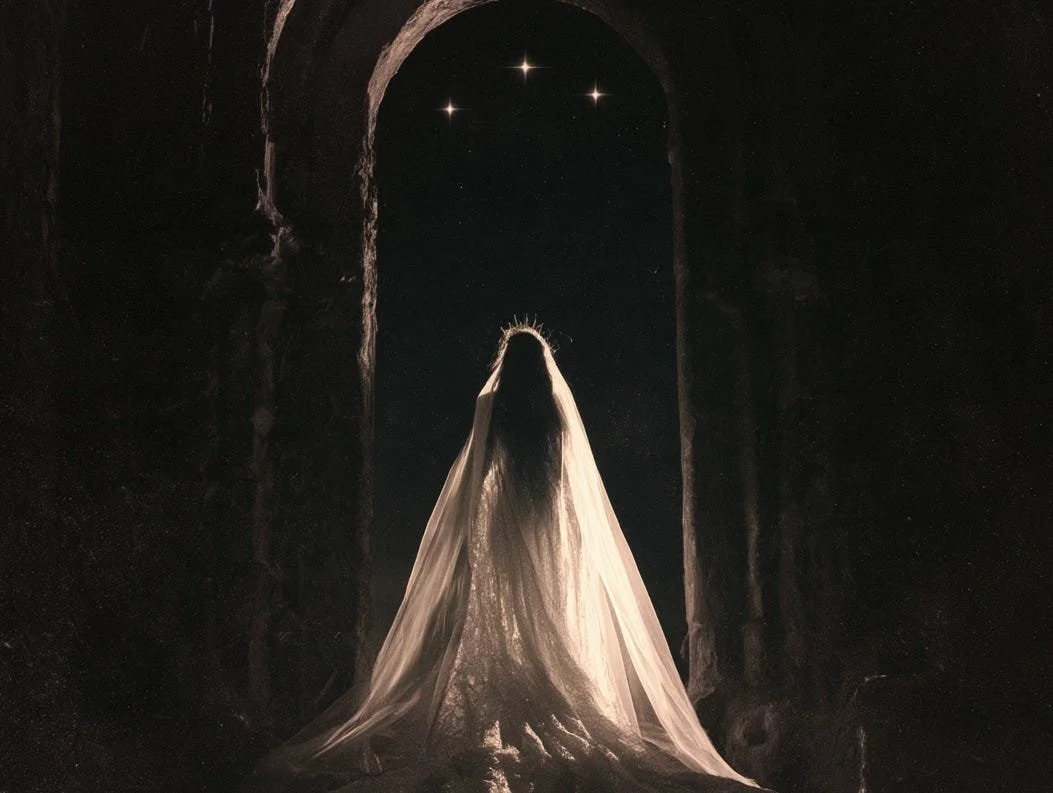
Again and again, my experience of helping my mom and her ultra-Orthodox friends eat mushrooms is that they will do all the normal stuff like walking barefoot in the grass, staring at mirrors and their hands, and belly laughing, but then also they will storm God’s throne room and start making demands for their kids.
Part of what unites my mom and this particular group of mothers is the bond that’s formed between them as they’ve navigated the choices of one or more of their children (such as me) to no longer remain Orthodox. In doing so they have formed a sisterhood. Despite others around them choosing to turn their backs on or even excommunicate their wayward children, they took their children’s choices as reasons to do more exploring, soul-searching, processing and praying.
I’d hate to be an angel trying to keep the door to that throne room shut — standing in the way of an ensouled, free-willed, made-in-the-image-of-God mother-of-His-children head full of hyperconnected-psilocybin-neurons-woman cruising along Jacob’s ladder with a big list of things that should be different.
I’d hate to be standing on one leg trying to keep my suddenly sweating hands wrapped around my flaming sword as a human being with the capability to Speak the divine language and to live, even sleep, in a world where God’s light is not visible, running at me with a comet’s tail of tears trailing behind her, Hebrew matrix code streaming from her mouth as she screams improvised prayers louder than all the heavenly choirs’ song.
Requests happen too — but Jewish mothers feel comfortable making demands of the Most High. My mother told God: “You must heal my son of his illness by his birthday. You just have to.” I’m much better now. My birthday is this month.
In the Talmud it says: “Since the destruction of the Temple, the gates of prayer are locked. But the gates of tears are never locked.”
The prayers just arise, and rarely for themselves. Once, when we chose to spend Shabbat on a fairly obscure research chemical I’ve come to love for its meaning-and euphoria-enhancing properties, we spent a while going from object to object in the therapy office she designed herself in what used to be my little sister’s room. The pink dressers and mirrors were replaced by all manner of somatic therapy devices — ropes, plushies, low couches.
She went from decoration to decoration — Incan artifacts from her Peruvian mother, a drawing from her youth, a bookshelf of notes from her many classes and workshops. As we did I could feel the arylcyclohexylamine-hypomania that’s so familiar to me arise — everything more salient, more pregnant with meaning, more important — but as it did in her I could see it was fueling compassion more than mania. She turned to me and asked for some time alone in the room. “I need to pray for each of my clients.”
When she finally emerged from her room we spent the rest of the day and some of the night singing Shalshudis songs. Shalshudis is a beautiful little trick used to hang on to the skirt of the feminine manifestation of the divine presence of God just a little bit longer — if one sings to her, the Sabbath queen stays in the room even after the third star rises in the sky.
It’s always lovely, but that night with a head full of NMDA antagonists every song brought waves of chills, swells of meaning, breakers of tingles, ripples of beauty, billows of love. When we finally tapped out we transitioned into a Melaveh Malkah — an escorting of the queen — and played her out, this time dancing to electronic music from powered speakers, now that the Sabbath was gone.
This is an old pattern in ancient Jewish stories of The Mothers. Rachel, upon watching her children march past her grave in chains as they are expelled to Babylon, bursts into heaven to find God in absolute anguish, eulogizing Himself. Metatron, the highest of all angels, the very prince of the divine countenance, falls upon his face and begs to do the crying instead; God, infuriated, threatens to retreat to a place of Hiddenness where no angel can go and demands to be left to His sorrow. He instructs Jeremiah to wake the dead. “Bring me the forefathers. They know how to weep,” God says.
Each of The Fathers arrives and argues from Merit: each listing their sacrifice and toils, hoping to gain enough favor to rescue their children from the land of their servitude. None of this moves God. Then appears Rachel, who argues from her flesh and blood, from her setting aside her own jealousies for the sake of even her own rival. “If I can do it, Lord of Hosts, why can’t You?”
That’s what works. God picks Himself off the ground of being: His mercies roll over:
כֹּה אָמַר ה’ קוֹל בְּרָמָה נִשְׁמָע נְהִי בְּכִי תַמְרוּרִים רָחֵל מְבַכָּה עַל בָּנֶיהָ מֵאֲנָה לְהִנָּחֵם עַל בָּנֶיהָ כִּי אֵינֶנּוּ.
כֹּה אָמַר ה’ מִנְעִי קוֹלֵךְ מִבֶּכִי וְעֵינַיִךְ מִדִּמְעָה כִּי יֵשׁ שָׂכָר לִפְעֻלָּתֵךְ נְאֻם ה’ וְשָׁבוּ מֵאֶרֶץ אוֹיֵב.
וְיֵשׁ תִּקְוָה לְאַחֲרִיתֵךְ נְאֻם ה’ וְשָׁבוּ בָנִים לִגְבוּלָם
“Thus said the Lord: A voice is heard in Ramah, wailing, bitter weeping — Rachel weeping for her children. She refuses to be comforted for her children, for they are gone.
Thus said the Lord: Hold back your voice from weeping and your eyes from tears, for there is reward for your work, says the Lord. They shall return from the land of the enemy.
And there is hope for your end, says the Lord. The children shall return to their home.”
I sent a rough draft of the above to my mother and her friends and they responded with a beautiful voice note full of lovely kvelling that I will treasure forever. They told me on a separate follow-up trip they cried again, reading this story of themselves, and that after, they sang those words together, of Mameh Rochel Crying.
They told me the prayers loosed from their tongues when mushrooms are in their bellies are the best of their lives. They also sent me a video of my mother cartwheeling down a hallway after the cocktail of tryptamines and arylcyclohexylamines I had prepared for her had hit.
On another dose, one of my mother’s friends, a daughter of Holocaust survivors, stood up from the fetal position — she had just sobbed for the first time in decades — and bellowed that she was dropping her nickname forever and that her full name was her real name from now on. The Talmud speaks of this: charity, crying out, changing one’s deeds, and lastly changing one’s name are listed as the four ways to annul an evil decree against one’s soul.
Her kids say she’s now able to hug them for much longer.
The Arizal teaches that the naming of a child is a form of Ruach Hakodesh, of divine inspiration; God puts it into the mouths of the parents Himself. A woman emerged from the hell of the camps and gave her daughter this name, who buried it under a nickname for decades. Then on that holy day she stood up off the floor the mushroom had called her to and took it back.
Dear reader, it is with tears in my eyes that I tell you her full, God-given name:
Nechamah.
Consolation.
Sources
Gates of tears — Talmud Bavli, Berakhot 32b, attributed to R. Elazar.
Shalshudis (Shalosh Seudos) — the third Sabbath meal. The Arizal identified this hour as ra’ava d’ra’avin, the will of wills — the moment of greatest divine favor. The zemer traditionally sung at it, Bnei Heichala, is the Arizal’s own Aramaic composition.
Rachel’s grave — Bereshit Rabbah 82:10; Rashi on Genesis 48:7. Jacob buried her by the road so that when the exiles passed on their way to Babylon, she could weep and plead for them.
Rachel before the throne — God eulogizing Himself, Metatron, Hiddenness, Jeremiah waking the dead, the four Fathers, Rachel’s argument — Eichah Rabbah, Petichta 24 (Vilna ed.; text varies in the Buber ed.). A shorter parallel appears at Tanna d’vei Eliyahu 28.
“Bring me the forefathers. They know how to weep” — Eichah Rabbah, Petichta 24. Paraphrased.
A place of Hiddenness — Eichah Rabbah, Petichta 24, citing Jeremiah 13:17. On Hiddenness (mistarim) as an actual chamber where God weeps, inaccessible to angels, see Chagigah 5b.
“If I can do it, Lord of Hosts, why can’t You?” — Eichah Rabbah, Petichta 24. She, flesh and blood, dust and ashes, was not jealous of her rival — so why was God jealous of idols with no substance in them. The line as it appears here is my compression.
His mercies roll over — Eichah Rabbah, Petichta 24.
Metatron — 3 Enoch (Sefer Hekhalot) 4, 10, 12. Titled sar ha-panim, prince of the divine countenance, and YHWH ha-katan, the lesser YHWH. He is Enoch, transformed — an angel who was once human. See Chagigah 15a for the Talmudic version.
“A voice is heard in Ramah” — Jeremiah 31:14–16. Read as the haftarah for the second day of Rosh Hashanah — see Megillah 31a.
Four ways to annul a decree — Rosh Hashanah 16b. R. Yitzchak: four things tear up a person’s decree — charity, crying out, changing one’s name, and changing one’s deeds. Some add a fifth, changing one’s place.
Naming as Ruach Hakodesh — R. Isaac Luria, Sha’ar HaGilgulim, introduction 23; Emek HaMelech, Sha’ar 1 ch. 4. When parents name a child, God places in their mouths the name that corresponds to that soul. See also Bereshit Rabbah 72: the matriarchs were prophetesses, and the patriarchs were beneath them in prophecy — which is why Rachel and Leah name the tribes.
My favorite melody for the passages about Rachel the Matriarch:
The song they sang on their trip:
