Paleo-Judaism
When people speak of Judaism, images arise of things like challah and halachic discourse and communal prayer. These things are absolutely genuinely Jewish. But Judaism isn’t just Yiddish in Hebrew script over a deli, it’s also Paleo-Hebrew etched in limestone.
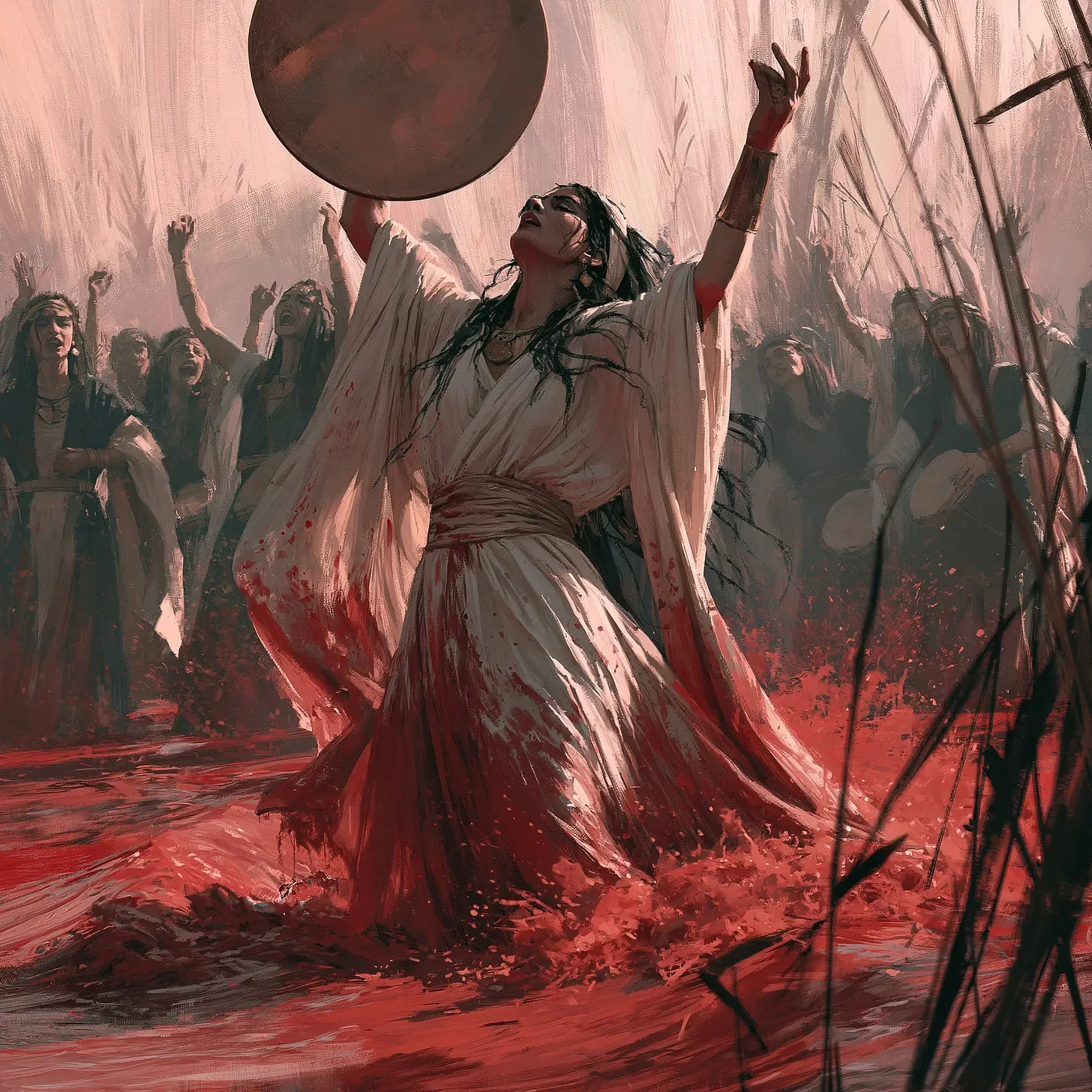
It’s also a high prophetess knee-deep in bloody seawater and reeds holding a skin-drum above her head ululating and prance dancing in ecstatic mania, receiving divine revelation in celebration of a martial victory over Egypt as all the women of Israel join her in song. It is “singers in front, players behind, in the middle, girls drumming” it is “decking yourself with frame-drums and going out in the dancing of the merrymakers.”
Judaism is twelve standing stones, upright stelae at the foot of a smoking trembling mountain; the throwing of blood, and the divine revelation of the elders; visions of a ground made of lapis-lazuli brick, blue, gold flecked, under the very feet of God; “like the very bone of the sky for clearness”.
Judaism is also a man in ceremonial garb, bells and gems and anointed in potent fragrant oils, mixing frankincense and cannabis smoke in an enclosed room in the desert, staring at a red painted obelisk as he begins to tremble in awe.
Judaism is the nation’s king stripping naked, falling on his face, and entering the prophetic trance state, day and night. Judaism is altar-blood on the ear, on the thumb, on the toe. Mixed among the drops, sacred psychoactive anointing oils; pearls of it flowing up and down the beard of the priest who chases peace.
Judaism is the winged sphinxes, bones of olive wood, skin of gold, silently gazing, in the fatal silence of the Holy of Holies; and the ones atop the ark of the covenant, revealed to the pilgrims on the day of the festival, in full passionate embrace, “clinging, touching, intertwined, as male embraces female”.
Judaism is spending ten percent of one’s annual produce on a pilgrimage feast in the presence of the divine; the commandment to buy not just wine but strong drink and “whatever your throat/soul/self craves”; swearing that not one bite was initiated with sadness; feasting and drinking with one’s family.
Judaism, as much as it is apples in honey, is all the daughters of Jerusalem donning identical flowing white dresses, dancing erotically amongst the grapevines on the holiest day of the year, as the men ogle from aside, each beginning to sense who they will pair off with.
Judaism is the tamarisk tree of Abraham and El Olam at Beersheba; Judaism is “the Soothsayers’ Terebinth”, and the terebinth trees of Mamre, venerated for 1500 consecutive years; the acacia of the incense altar, the cedars of Lebanon and the date palm of Devorah.
This other older kind of Judaism is often either denied as heretical or defunct by the Orthodox, or co-opted for modern brainworms by academics. But they can’t take it away from me. It’s mine as much as theirs.
What is mine is not dead. What is mine is still living; tamed perhaps, to some extent, by encounters with more advanced civilizations who taught us new ways of writing and thinking, but still alive, a pacing bear in the courtyard. In a cage made of human ribs something still beats in the Jew; something old, something of the desert, something hot and bloody and hungry. The throat-soul-self calls to be slaked by something it has merely tasted. But we need to be drenched.
“Deep calls to deep at the voice of your waterspouts; all Your breakers and waves have passed over me.” Oh Lord of the Ancients! Most Ancient One, who is before the first thought and after the last deed! Let your water spout, breakers break, waves wave.
We are ready for something old again.
Addendum and Sources
When people speak of Judaism, images arise of things like challah and halachic discourse and communal prayer. These things are absolutely genuinely Jewish. But Judaism isn’t just Yiddish in Hebrew script over a deli, it’s also Paleo-Hebrew etched in limestone.
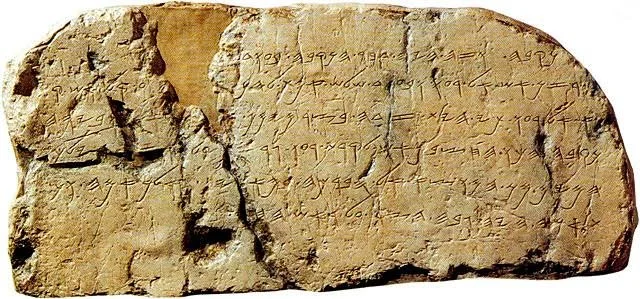
Siloam Tunnel inscription, c. 700 BCE
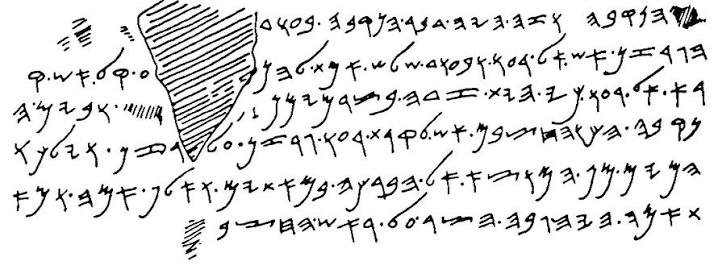
Siloam Tunnel inscription, c. 700 BCE, facsimile drawing
“While [the stonecutters were swinging] the axe one toward the other, and while there were still three cubits to be cut th[rough, there was hear]d the sound of one calling to the other, for there was a zdh in the rock on the right and on the [le]ft. And on the day of the cutting-through, the stonecutters were hewing each toward the other, axe upon [a]xe. And the water flowed from the outlet to the pool for one thousand [and t]wo hundred cubits. And one hu[nd]red cubits was the height of the rock over the heads of the stonecutter[s].”
Example of post-exilic square script, with exception of the Tetragrammaton in the center still written in Paleo-Hebrew Pre-exile script
It’s also a high prophetess knee-deep in bloody seawater and reeds holding a skin-drum above her head ululating and prance dancing in ecstatic mania, receiving divine revelation in celebration of a martial victory over Egypt as all the women of Israel join her in song. It is “singers in front, players behind, in the middle, girls drumming” it is “decking yourself with frame-drums and going out in the dancing of the merrymakers.”
high prophetess… skin-drum… all the women of Israel — Exodus 15:20–21. Miriam’s couplet (v. 21) is the opening line of the Song of the Sea (15:1–18), which with Judges 5 is widely considered the oldest poetry in the Bible. It has its roots in the oldest forms of Levantine prophecy — ecstatic war-band revelations of the divine.
bloody seawater — Exodus 14:30.
“singers in front, players behind, in the middle, girls drumming” — Psalm 68:26 (Heb.; 68:25 Eng.). Author’s translation.
“decking yourself with frame-drums and going out in the dancing of the merrymakers” — Jeremiah 31:4. Author’s translation.
for an excellent percussive rendition of the song in the original Hebrew: https://youtu.be/Y3CbZB1hsiQI have been fascinated by the powerful positions biblical women held. When Josiah's high priest finds a scroll of the Torah in the Temple and the king needs it authenticated, he sends five men — the high priest himself among them — to the highest spiritual authority in the land: a prophetess named Huldah (2 Kings 22:14–20). Jeremiah was alive and in Jerusalem. The Bible offers no explanation for why they went to her instead, and nobody in 622 BCE seems to have needed one. It is not until nine centuries later that the Talmud does (Megillah 14b). It is impossible for me to imagine something equivalent in today's Orthodox Judaism. The scroll she authenticated, by most scholarly accounts, was the core of Deuteronomy.
Judaism is twelve standing stones, upright stelae at the foot of a smoking trembling mountain; the throwing of blood, and the divine revelation of the elders; visions of a ground made of lapis-lazuli brick, blue, gold flecked, under the very feet of God; “like the very bone of the sky for clearness”.
twelve standing stones — Exodus 24:4.
smoking trembling mountain — Exodus 19:18.
the throwing of blood — Exodus 24:6, 8.
the divine revelation of the elders… lapis-lazuli brick… under the very feet of God… “like the very bone of the sky for clearness” — Exodus 24:9–11. Sappir in Iron Age usage is lapis lazuli. Author’s translation (NJPS: “like the very sky for purity”).
Judaism is also a man in ceremonial garb, bells and gems and anointed in potent fragrant oils, mixing frankincense and cannabis smoke in an enclosed room in the desert, staring at a red painted obelisk as he begins to tremble in awe.
bells and gems — Exodus 28:17–21 (stones), 28:33–35 (bells). I can’t be certain the priest at Tel Arad wore the same garments as the priests in the central Temple, but he was probably wearing a priestly vestment of some kind.
anointed in potent fragrant oils — Exodus 30:22–33. Rabbi Aryeh Kaplan, in his Living Torah translation, quotes linguists who make a solid case that kaneh bosem in the anointing oil ingredients is cannabis: Sula Benet (Sara Benetowa), “Early Diffusion and Folk Uses of Hemp,” in Cannabis and Culture, ed. Vera Rubin (The Hague: Mouton, 1975), 39–49; orig. Warsaw, 1936. Benet argues that Heb. qaneh shares a root meaning “hemp/reed” with Akk. qunnabu, that the Septuagint’s kalamos was a mistranslation later copied universally, and that qaneh bosem fused into Mishnaic kanbos = “cannabis.” I will present the strongest arguments I have found for this in a later article; for now I will just say the empirical evidence of ritual cannabis use at Tel Arad in the next note is enough for me, separate from any etymological debate.
frankincense and cannabis smoke in an enclosed room in the desert — Eran Arie, Baruch Rosen & Dvory Namdar, “Cannabis and Frankincense at the Judahite Shrine of Arad,” Tel Aviv 47:1 (2020), 5–28. The two limestone altars stood at the entrance to the shrine’s inner cella, Stratum IX–VIII, 8th c. BCE. The cannabis sat on a base of animal dung, which burns at the low temperatures needed to vaporize THC; the frankincense beside it sat on animal fat, which burns at the much higher temperature frankincense requires.
red painted obelisk — the Arad standing stone: Y. Aharoni, “Arad: Its Inscriptions and Temple,” Biblical Archaeologist 31 (1968); Z. Herzog, “The Fortress Mound at Tel Arad: An Interim Report,” Tel Aviv 29 (2002).
Judaism is the nation’s king stripping naked, falling on his face, and entering the prophetic trance state, day and night. Judaism is altar-blood on the ear, on the thumb, on the toe. Mixed among the drops, sacred psychoactive anointing oils; pearls of it flowing up and down the beard of the priest who chases peace.
the nation’s king stripping naked… prophetic trance state, day and night — 1 Samuel 19:23–24; cf. 10:5–13.
altar-blood on the ear, on the thumb, on the toe — Leviticus 8:23–24 (Aaron’s ordination); cf. Exodus 29:20.
Mixed among the drops, sacred… anointing oils — Leviticus 8:30.
pearls of it flowing up and down the beard — Psalm 133:2 (yored al hazakan); b. Horayot 12a (par. b. Keritot 5b): two drops like pearls hung on Aaron’s beard, and when he spoke they would rise and settle at its roots.
the priest who chases peace — Mishnah Avot 1:12 (Hillel: “be of the disciples of Aaron, loving peace and pursuing peace”).
Judaism is the winged sphinxes, bones of olive wood, skin of gold, silently gazing, in the fatal silence of the Holy of Holies; and the ones atop the ark of the covenant, revealed to the pilgrims on the day of the festival, in full passionate embrace, “clinging, touching, intertwined, as male embraces female”.
winged sphinxes, bones of olive wood, skin of gold… Holy of Holies — 1 Kings 6:23–28; 2 Chronicles 3:10–13. On cherubim as sphinx-form throne guardians: Othmar Keel, The Symbolism of the Biblical World (1978), 167–71.
fatal silence — Leviticus 16:2; cf. Numbers 4:20: the death penalty for unauthorized entry. Even when authorized, oral traditions tell of an extremely high death rate; the High Priest entered with a golden chain around his leg so that he could be dragged out in the fairly likely event of his death. Zohar III, Acharei Mot 67a / Emor 102a
the ones atop the ark of the covenant — Exodus 25:18–20 (hammered gold, facing each other, wings screening the cover).
revealed to the pilgrims on the day of the festival, in full passionate embrace — b. Yoma 54a (Rav Ketina).
“clinging, touching, intertwined, as male embraces female” — Rashi on b. Yoma 54a, s.v. me’urim; author’s translation. Cf. b. Bava Batra 99a on the cherubim’s changing posture.
Judaism is spending ten percent of one’s annual produce on a pilgrimage feast in the presence of the divine; the commandment to buy not just wine but strong drink and “whatever your throat/soul/self craves”; swearing that not one bite was initiated with sadness; feasting and drinking with one’s family.
ten percent of one’s annual produce on a pilgrimage feast in the presence of the divine — Deuteronomy 14:22–26.
not just wine but strong drink and “whatever your throat/soul/self craves” — Deuteronomy 14:26. Nafshekha carries all three senses — throat, appetite, self — and the choice among them is contextual.
swearing that not one bite was initiated with sadness — Deuteronomy 26:14 (be’oni), from the tithe declaration of 26:12–15.
feasting and drinking with one’s family — Deuteronomy 14:26; cf. 12:7, 12, 18.
Judaism, as much as it is apples in honey, is all the daughters of Jerusalem donning identical flowing white dresses, dancing erotically amongst the grapevines on the holiest day of the year, as the men ogle from aside, each beginning to sense who they will pair off with.
apples in honey — Tur, Orach Chayim 583, and Rema ad loc.
daughters of Jerusalem… identical flowing white dresses… grapevines… holiest day of the year — Mishnah Ta’anit 4:8; b. Ta’anit 30b–31a.
Judaism is the tamarisk tree of Abraham and El Olam at Beersheba; Judaism is “the Soothsayers’ Terebinth”, and the terebinth trees of Mamre, venerated for 1500 consecutive years; the acacia of the incense altar, the cedars of Lebanon and the date palm of Devorah.
tamarisk tree of Abraham and El Olam at Beersheba — Genesis 21:33.
“the Soothsayers’ Terebinth” — Judges 9:37 (Elon Me’onenim). Author’s translation.
terebinth trees of Mamre, venerated for 1500 consecutive years — Genesis 13:18; 18:1. Continuity: Josephus, War 4.533 (the terebinth “said to have stood since the creation”); Eusebius, Life of Constantine 3.51–53 (the mixed fair and cult suppressed by imperial order, c. 330 CE); Sozomen, Ecclesiastical History 2.4 (Jews, pagans and Christians still gathering there in his day, mid-5th c.). The number depends on the start date; Iron Age text to Constantine is roughly 1200–1500.
the acacia of the incense altar — Exodus 30:1 (acacia overlaid with gold); cf. 27:1 (burnt-offering altar), 25:10 (ark).
the cedars of Lebanon — Psalm 104:16 (”the trees of YHWH… the cedars of Lebanon that he planted”); 1 Kings 5:20 (Heb.; 5:6 Eng.).
the date palm of Devorah — Judges 4:5.
This other older kind of Judaism is often either denied as heretical or defunct by the Orthodox, or co-opted for modern brainworms by academics. But they can’t take it away from me. It’s mine as much as theirs.
What is mine is not dead. What is mine is still living; tamed perhaps, to some extent, by encounters with more advanced civilizations who taught us new ways of writing and thinking, but still alive, a pacing bear in the courtyard. In a cage made of human ribs something still beats in the Jew; something old, something of the desert, something hot and bloody and hungry. The throat-soul-self calls to be slaked by something it has merely tasted. But we need to be drenched.
“Deep calls to deep at the voice of your waterfalls; all Your breakers and waves have passed over me.” Oh Lord of the Ancients, Most Ancient One who is before the first thought and after the last deed! Let your water fall, breakers break, waves wave. We are ready for something old again.
“Deep calls to deep…” — Psalm 42:8 (Heb.; 42:7 Eng.). Author’s translation; tzinorekha, lit. “your channels.”
Lord of the Ancients, Most Ancient One — Daniel 7:9 (Atik Yomin, “Ancient of Days”); Zohar III 128a ff. (Idra Rabba), Atika Kadisha.
before the first thought and after the last deed — inverting Lecha Dodi, sof ma’aseh bemachashavah techilah, “last in deed, first in thought” (Shlomo Alkabetz, Safed, c. 1540); cf. Adon Olam.
